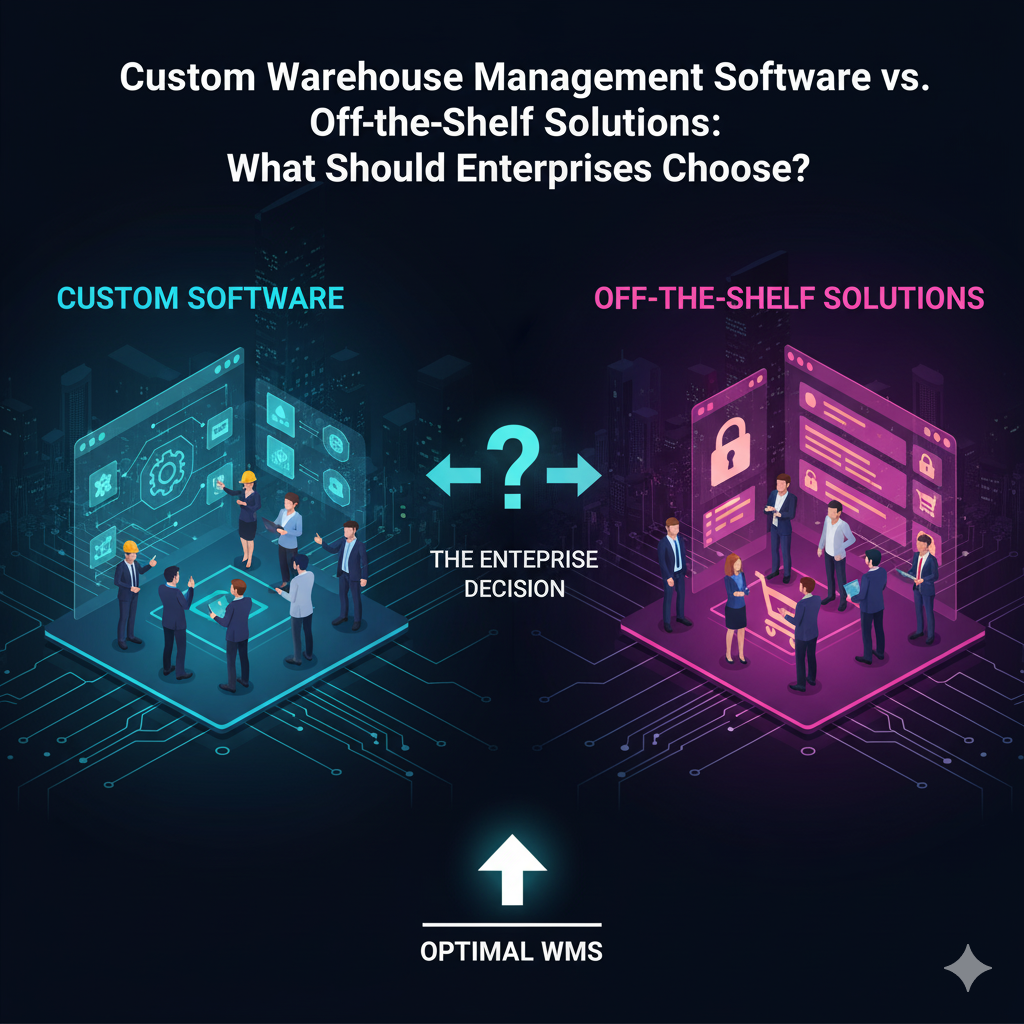

The global supply chain is evolving faster than ever, and warehouses are at the center of this transformation. With e-commerce booming, customer expectations rising, and operations becoming more complex, enterprises are increasingly relying on warehouse management software (WMS) to streamline processes, improve visibility, and boost efficiency.
However, one major dilemma persists for enterprises: Should you choose custom warehouse management software or go with an off-the-shelf WMS solution?
Both options come with advantages and limitations, and the right choice ultimately depends on business size, process complexity, scalability needs, and long-term digital transformation goals.
In this comprehensive guide, we break down the differences between the two, weigh the pros and cons, and help enterprises make an informed decision—backed by real-world scenarios and expert insights from a leading Warehouse Management Software Development Company.
Understanding the Two Approaches
Before diving into comparisons, it’s important to understand what each approach entails.
1. Off-the-Shelf Warehouse Management Software
These are ready-made WMS products built for general warehouse operations. They come with predefined features, workflows, and integrations that suit a wide range of use cases. Examples include Oracle WMS, SAP EWM, Manhattan WMS, and Zoho Inventory.
Best for:
SMEs, startups, or businesses with standard warehousing needs and basic automation goals.
2. Custom Warehouse Management Software
This is a tailor-made WMS solution designed specifically around an enterprise’s requirements—built from scratch or using a modular framework. A Warehouse Management Software Development Company works closely with your team to create a system that aligns with existing processes and future scalability needs.
Best for:
Enterprises with complex operations, multi-location warehouses, automation goals, or unique workflow requirements.
Custom WMS vs. Off-the-Shelf Solutions: A Detailed Comparison
1. Feature Flexibility & Customization
Off-the-Shelf
Ready-made WMS platforms are built for mass general use. They include common features such as inventory tracking, barcode scanning, pick-pack-ship workflows, order management, etc.
But limitations arise when businesses require:
- Custom workflows
- Automation beyond standard features
- Integration with legacy platforms
- Multi-region compliance
- Advanced demand forecasting
Customizing an off-the-shelf solution is often expensive and still limited by the provider’s framework.
Custom WMS
A custom solution can be built to match unique business needs. Whether it’s custom reporting dashboards, AI-based demand predictions, route planning, or automation workflows—everything can be tailored from the ground up.
Ideal for:
Warehouses with proprietary workflows or unique industry requirements (FMCG, pharma, cold chain, 3PL).
2. Scalability & Future Growth
Off-the-Shelf
Scalability depends on the vendor’s ecosystem. Some off-the-shelf systems charge hefty fees for user expansion, additional modules, or warehouse additions. Enterprises may also be restricted by system performance during high-scale operations.
Custom WMS
Designed with future growth in mind, a custom WMS scales seamlessly with expanding operations—new users, multiple warehouses, automation systems, robotics, and IoT devices can be added without constraints.
This is one reason enterprises often partner with a mobile app development company in USA or a WMS development specialist to build scalable, cloud-based systems.
3. Cost Structure: Short-Term vs. Long-Term Investment
Off-the-Shelf
- Lower upfront cost
- Monthly or yearly subscription fees
- Extra charges for add-ons, integrations, users, or premium support
- Increasing expense as business scales
Initially, it appears cost-effective but becomes expensive for long-term enterprise operations.
Custom WMS
- Higher initial investment
- No recurring licensing fees
- Total ownership of code and platform
- Lower long-term operational cost
For enterprises planning long-term digital transformation, custom WMS yields better ROI.
4. Integration Capabilities
Off-the-Shelf
Integrating with ERP, CRM, POS, TMS, robotics systems, or IoT devices may require:
- Third-party connectors
- Costly API access
- Vendor-dependent architectures
These systems often work best within their own ecosystem (e.g., SAP integrating best with SAP).
Custom WMS
A custom-built WMS seamlessly integrates with:
- SAP, Oracle, Microsoft Dynamics, NetSuite
- Legacy ERP systems
- TMS and last-mile delivery platforms
- E-commerce marketplaces
- Barcode scanners & handheld devices
- IoT and robotics systems
Integration flexibility is one of the biggest advantages.
5. Implementation Speed
Off-the-Shelf
Ready-made, meaning faster deployment—sometimes within weeks.
But…
Operational alignment requires businesses to adapt to the system, not vice versa. Training teams and reworking workflows may delay real adoption.
Custom WMS
Takes longer to develop (3–8 months typically), as it involves:
- Requirement analysis
- System architecture design
- UI/UX design
- Development
- Testing
- Integration
- Deployment
But the result is a solution built around your existing workflows—minimizing change management issues.
6. Ownership, Security & Compliance
Off-the-Shelf
- Vendor controls security updates
- Shared cloud infrastructure
- Limited data ownership
- Compliance depends on vendor policies
- Risk of vendor lock-in
Industries with heavy compliance needs (like pharma, aerospace, or cold chain logistics) often find these limitations concerning.
Custom WMS
A custom solution provides:
- Complete data ownership
- Enhanced security architecture
- Compliance with regional regulations (FDA, ISO, GDPR, etc.)
- Enterprise-grade encryption and access control
Security can be tailored to sensitive operations and multi-region compliance.
7. User Experience & Workflow Optimization
Off-the-Shelf
UI/UX is standard across all users. Employees may have to adjust to workflows that don’t match actual operations.
Custom WMS
Custom UI/UX designs ensure:
- Minimal steps for each task
- Tailored dashboards for workers, managers & admins
- Smooth navigation
- Optimized workflows for faster execution
- Higher productivity and fewer errors
Enterprises often rely on a mobile app development company in USA to build modern mobile-friendly WMS applications for warehouse workers.
Which Option Should Enterprises Choose?
The choice depends on business complexity, budget, growth plans, and integration needs.
Below are real-world scenarios to help decide:
Choose Off-the-Shelf WMS If:
- You are a small business or mid-size enterprise with standard warehouse operations
- You need a quick deployment
- You don’t require deep customization
- Budget constraints are a major concern
- You prefer vendor-managed updates and support
Best for:
Startups, small retail stores, distributors, small 3PLs.
Choose Custom WMS If:
- You have multi-location or multi-country warehouses
- Your workflows are complex or unique
- You require advanced automation or robotics integration
- You need AI-based forecasting, analytics & reporting
- You want full control over security and data ownership
- You expect rapid growth in the next 3–5 years
Best for:
Large retailers, FMCG giants, e-commerce companies, pharma & cold chain logistics, manufacturing enterprises, and 3PLs.
How a Warehouse Management Software Development Company Helps
A specialized Warehouse Management Software Development Company brings industry expertise, technical depth, and implementation experience to design:
- Custom WMS applications
- Cloud-based warehouse management platforms
- Mobile apps for warehouse staff
- AI & automation-powered analytics tools
- IoT integration for real-time tracking
- Robotics and automation system compatibility
They ensure the WMS aligns with your business models and stays scalable for the future.
Final Verdict: Custom WMS Delivers Maximum Long-Term Value
Off-the-shelf solutions are suitable for businesses seeking affordability and quick deployment. However, for enterprises with high-volume, multi-location, and complex warehouse operations, custom warehouse management software offers unmatched flexibility, scalability, and ROI.
As supply chain complexity increases globally, enterprises need systems that evolve with their workflows—not the other way around.
A custom WMS, built with the support of an experienced Warehouse Management Software Development Company or a mobile app development company in USA, empowers enterprises to optimize workflows, reduce costs, improve visibility, and build a future-proof supply chain.